

The Top 3 Crypto Security Best Practices Every Investor Needs
Ivan Bianco, a Brazilian crypto blogger, demonstrated his wallet setup during a live stream. However, he inadvertently included his seed phrase in a text file containing his passwords. Viewers briefly saw the phrase on screen, which led to a $60,000 drain from his account within minutes. Ironically, he realized the incident live on air when he noticed the outgoing transaction in a blockchain explorer.
This unfortunate incident serves as a cautionary tale.
To avoid similar occurrences, refer to our concise guide on advanced crypto security.
Multisig and Distributed Custody: Real-World Examples

In standard self-custody crypto wallets, control over funds hinges on a single seed phrase or private key. While convenient, this setup is highly vulnerable to mistakes or leaks, resulting in complete loss of control. Multisig addresses this issue by eliminating the dependency on a single secret key for total ownership.
In practice, multisig functions as an additional layer of security. Funds are held at an address or smart contract that can only move assets with multiple independent approvals. Even if one key is stolen or compromised, it remains useless.
Consider the most common and practical multisig setup: a “2-of-3” multisig. Three independent keys are created, each with its own unique seed phrase generated independently. These keys are distinct from one another, not copies or derivatives. Each key holds equal value and operates independently.
A rule is then established: any transaction must be approved by any two of the three keys. This rule is not informal or procedural; it is enforced at the protocol level. In Bitcoin-like systems, it is encoded into the address itself. In Ethereum and EVM-based systems, it is enforced by a smart contract. In practice, the most widely used implementation is a smart-contract wallet such as Safe, which is specifically designed to enforce multisignature control.
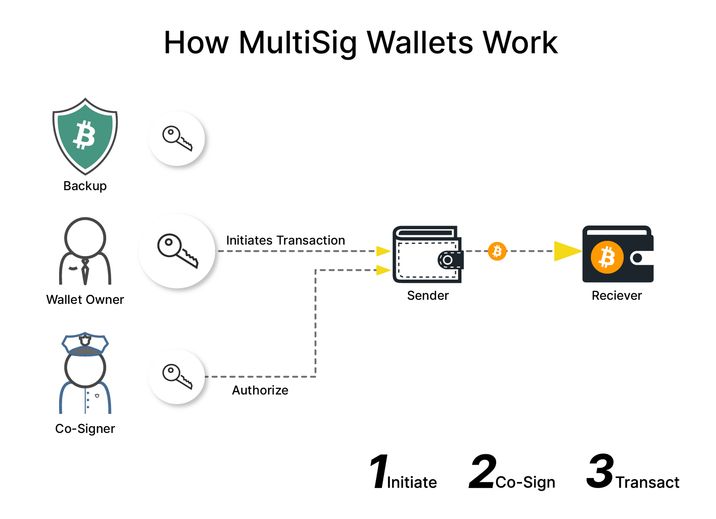
From that moment on, funds are no longer sent to a “wallet” in the conventional sense. Instead, they are sent to a multisig contract. This is where the user experience undergoes a significant transformation. When the owner wants to send funds, they do not immediately execute a transaction. Instead, one key simply proposes a transaction, specifying the recipient, amount, and adding its signature. At this stage, nothing moves; the funds remain in their original location.
A second key, usually on a different device and often in a different physical location, then reviews the proposed transaction. The user verifies the address and the amount, and then adds a second signature. Only when the required threshold—two signatures out of three—is reached does the contract allow the transaction to execute. The third key may never be involved at all. Its role is to provide redundancy and distribute risk.
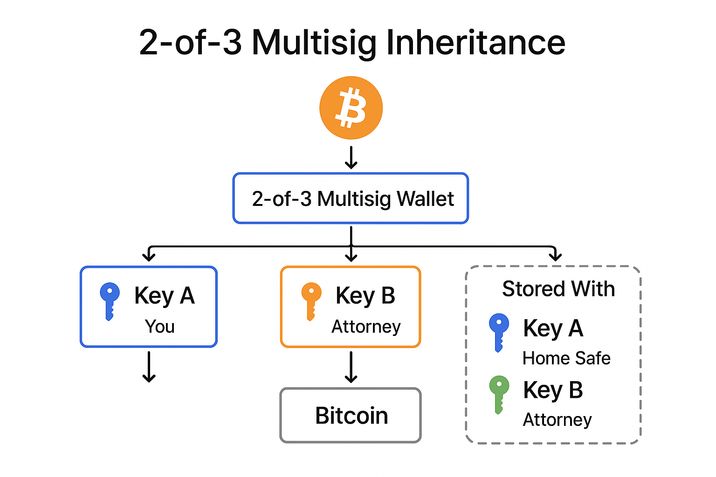
This structure has significant real-world implications. If one key is stolen, nothing happens. The attacker cannot transfer funds using a single signature. If one key is lost, access is not lost because the remaining two keys are sufficient. Even if a user is tricked into signing something malicious, the damage usually stops at the second step: without a second independent confirmation, the transaction cannot complete.
One of the most common mistakes beginners make is neglecting the location and method of key storage. Multisignature only works if keys are physically and logically separated. A mature setup typically consists of:
- – One hardware wallet used for regular operations and kept at home,
- – The second hardware wallet stored in a different physical location, such as an office, a safe, or with a trusted family member,
- – The third key kept strictly as a backup for recovery scenarios.
Multisig, when all keys are stored in a single location, becomes an illusion rather than a genuine security measure.
It’s crucial to comprehend that multisig isn’t a case of “more complexity equals more security.” One of the most prevalent failure modes is overengineering a scheme that becomes challenging or even intimidating to use. A well-designed multisig setup should be one that you can clearly explain to yourself a year later without relying on diagrams or instructions. If the system intimidates you, it’s already compromised.
Air-Gapped Systems: What They Really Are, How They Work, and How They Differ from Cold Wallets
The term “air-gapped” originates from classical information security and military systems, where it literally signifies that a system is isolated from other networks by an “air gap”—a physical absence of connectivity. A truly air-gapped system lacks any direct network connection and, consequently, cannot be accessed remotely over the internet.
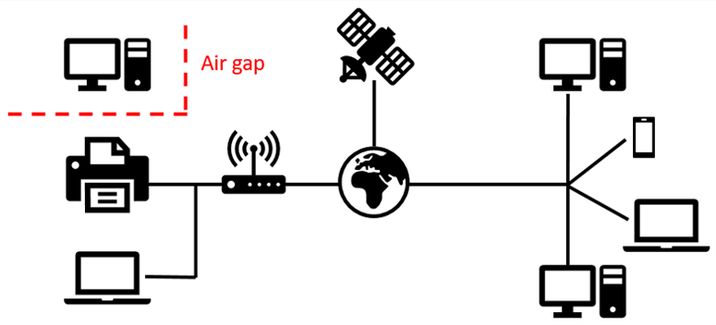
In the realm of self-custody wallets, an air-gapped system stands as a unique approach to storing and utilizing private keys. This system ensures that the device containing these keys remains disconnected from the internet and directly interfacing with online computers. No Wi-Fi, Bluetooth, or USB cable is allowed. Interaction with the outside world is limited to constrained, indirect channels such as QR codes or removable media like microSD cards.
It’s crucial to distinguish between air-gapped systems and cold wallets, even though they share some similarities.
A cold wallet refers to any setup where private keys are kept away from continuous internet exposure. Examples of cold storage include paper wallets and hardware wallets.
An air-gapped device, on the other hand, is specifically designed to prevent direct electronic communication with online systems. Simply plugging it into a computer and signing a transaction is not possible. Consequently, the transaction process is divided into two separate environments. An online computer is utilized solely for data preparation. It constructs an unsigned transaction, essentially a structured description of the desired action, such as sending a specific amount to a designated address. However, this computer lacks access to private keys, rendering it incapable of signing any transactions.
The unsigned transaction is then transferred to the offline device using a method that avoids establishing a live connection. This can be achieved by displaying a QR code that the offline device scans with its camera or by copying a file onto a memory card and physically inserting it into the device. Operating in isolation, the offline device verifies the transaction details and signs it using a private key that remains confined to that environment.
The signed transaction is subsequently transferred back to the online computer using the same disconnected method. The online computer simply broadcasts it to the network, acting as a courier rather than being part of the trusted security boundary.
The core security advantage of this architecture is that even a fully compromised computer cannot directly attack the private keys. It cannot send arbitrary commands, silently request signatures, or exfiltrate secrets through an interface. The only thing it can do is attempt to deceive the user by presenting a malicious transaction. That’s why air-gapped systems heavily rely on the offline device having its own screen and on the user carefully verifying addresses and amounts before approving anything.
It’s important to clarify that air-gapping isn’t “absolute security.” It’s a reallocation of risk.
Transaction Hygiene: What It Is, Why It Matters, and How to Practice It
Transaction hygiene is the discipline of interacting with blockchains consciously and deliberately, with a clear understanding of what you’re signing and what rights you’re granting. In cryptocurrency, funds are rarely lost due to private key hacking. More often, users lose money because they themselves authorize everything required—by approving a contract, signing a message, or confirming a transaction without fully comprehending the consequences.
Unlike traditional banking, a blockchain signature doesn’t always mean an immediate transfer of funds. In many cases, it grants long-term permissions, delegates control, or authorizes actions that may be executed later. This is why blindly clicking “Confirm” is one of the most dangerous habits in cryptocurrency. Even hardware wallets or air-gapped setups cannot protect you if you sign without understanding what you’re approving.
The most common risk area is smart contract permissions. When you approve a token, you’re not sending it—you’re allowing a contract to spend it on your behalf. If that approval is unlimited, it’s effectively a transfer of control. Over time, wallets accumulate many forgotten approvals, and these lingering permissions are one of the primary vectors for theft.
Another particularly hazardous category involves signatures that aren’t transactions. Users are frequently asked to “just sign a message” to log in, verify ownership, or claim something. These signatures cost no gas and appear harmless, but they can later be used to grant permissions or enable asset transfers. If you don’t comprehend the precise purpose of a signature, that alone is a reason to stop.
Practicing transaction hygiene ultimately involves shifting your mental model. Every signature should be treated not as a simple button click, but as a program execution with irreversible consequences. Before approving anything, you should verify addresses, amounts, and the source of the request, and understand whether you’re granting a one-time action or ongoing authority. Periodically reviewing and revoking old permissions is a fundamental security practice, not paranoia.
You can build the most sophisticated security architecture—cold keys, hardware wallets, air-gapped devices, multisig—but if you disregard basic common sense and routinely break your own rules, that protection quickly becomes meaningless. Advanced security isn’t defined by the tools you use, but by the habits you maintain. Technology only enforces discipline; it can’t replace it. In practice, real security always begins with behavior, and only then is reinforced by technical safeguards.